Treatments
A short procedure that releases a tight band of tissue under the tongue or lip so it can move freely.
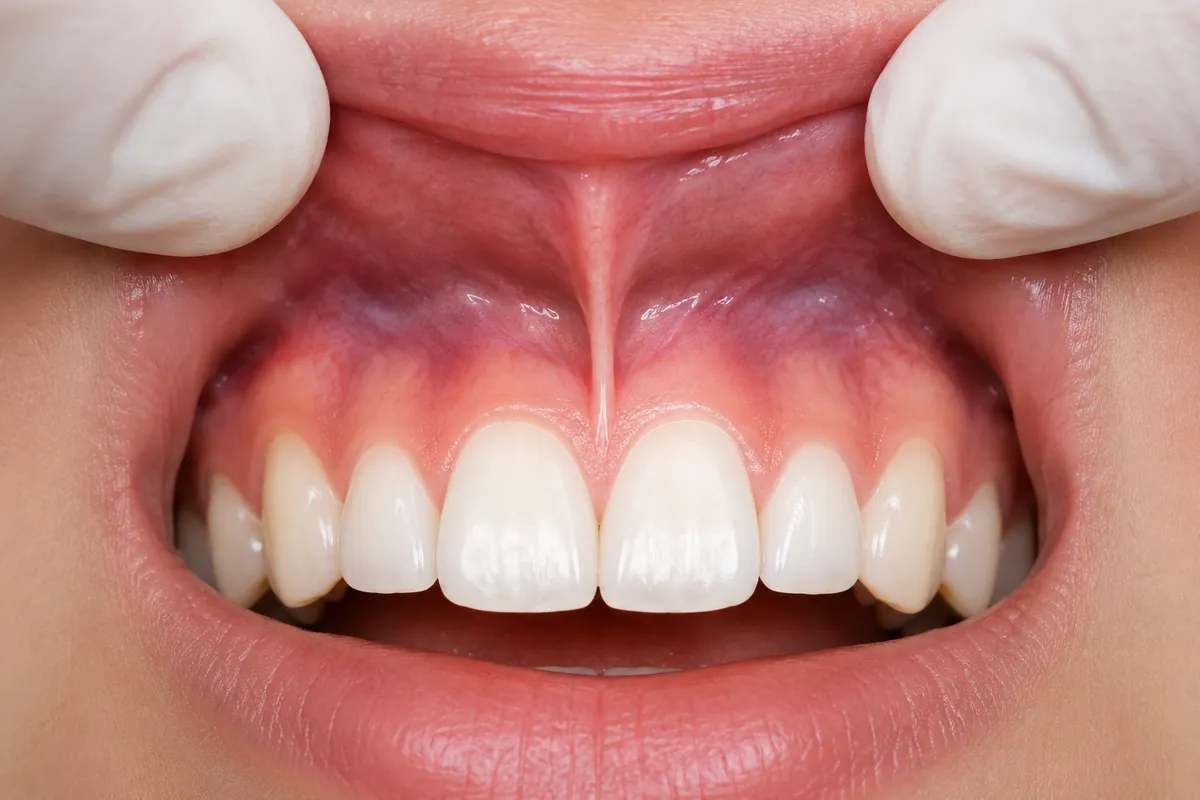
A frenulum is the thin band that connects the tongue to the floor of the mouth, or the lip to the gum. When it is too short or attached too far forward it restricts movement — what is usually called tongue-tie or lip-tie. A frenectomy releases that band. It is a small procedure and is normally finished in a single short visit.
Not ready to book? Chat with our team on WhatsApp
Releasing the band is only half the result. Once the tongue or lip can move properly, feeding, speech and gum health improve — and in adults, a denture or a brace that kept being pulled loose finally stays where it belongs.
Lingual frenectomy — the tongue band. When the band under the tongue is short, or attached close to the tip, the tongue cannot lift to the palate or reach the corners of the mouth. A baby struggles to latch and feed; a child or an adult is left with t, d, l, r and s sounds that stay unclear, and with lower front teeth that are hard to keep clean because the tongue cannot sweep across them.
Labial frenectomy — the lip band. When the band between the upper lip and the gum runs too low, it pulls on the gum every time the lip moves. Over the years that pull can hold open the gap between the two front teeth, draw the gum away from the tooth root, and unseat a denture or undo an orthodontic result that was otherwise correct.
Both are released surgically under local anaesthesia, in the same short appointment. Which of the two applies to you is decided at the examination.
We check how far the tongue lifts and moves sideways, where the band attaches, and how it is affecting feeding, speech or the gum. Photos and, for children, a short functional assessment are recorded.
If a brace, a denture or gum treatment is planned, we agree the timing first — a release carried out before orthodontics or a new denture protects the result.
The release is done surgically under local anaesthesia. The band is cut and, where needed, closed with a few resorbable stitches. Most cases take 10–20 minutes.
Simple tongue and lip exercises start the day after, so the tissue heals in its new, longer position. We review the site after about a week.
The release itself is done under local anaesthesia, so it is not felt. Afterwards most people describe a mild burning for a couple of days, much like a mouth ulcer, and manage with an ordinary painkiller.
Feeding usually improves the same day. Speech takes longer — the tongue has to learn movements it could not make before, so speech therapy alongside the procedure gives the fastest result.
It can retighten if the site is left still while it heals, which is exactly why the exercises matter. Done properly, the release is permanent.
This page is general information, not a diagnosis. Treatment planning is only possible after a clinical examination and radiographs at the clinic.

Sent via WhatsApp.
By clicking Send, your information will be converted into a WhatsApp message.
Your personal data is used solely for appointment purposes (GDPR/KVKK).
 Get Directions